







.svg)




Import your Shopify catalog

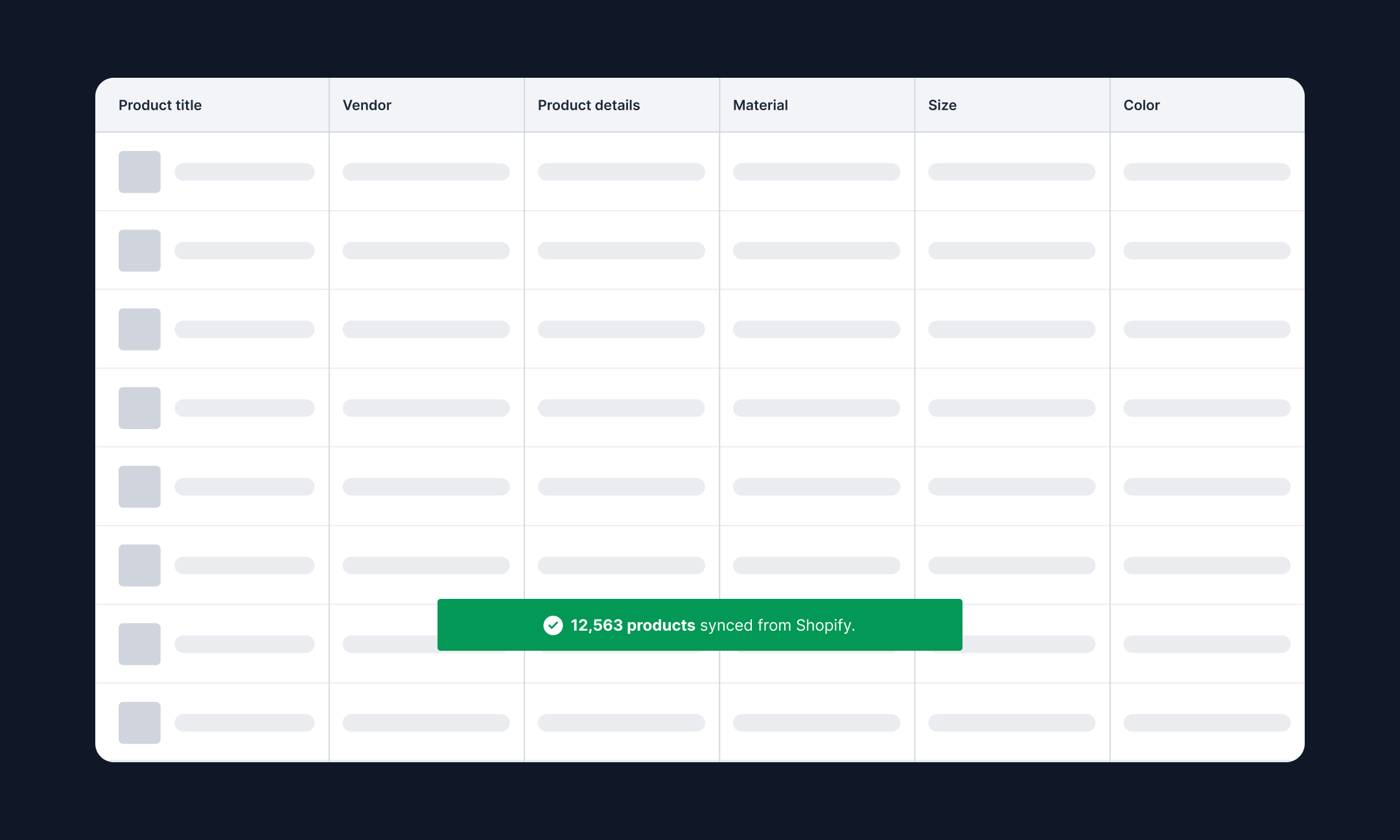
Syncs titles, descriptions, variants, tags, categories, images and metafields in bulk.
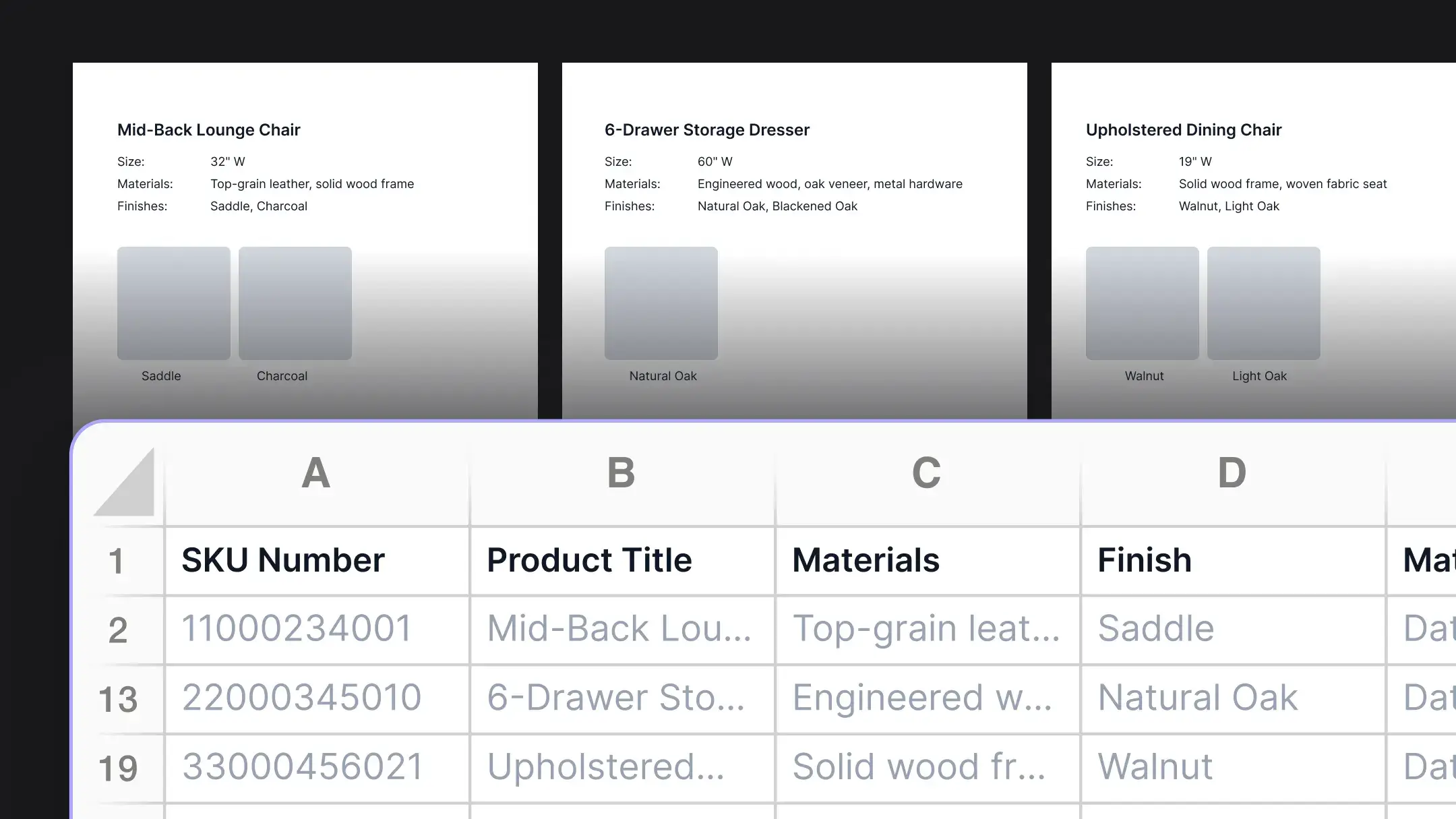
Combines your Shopify records with product data from your ERP and supplier feeds.
Models variants and product relationships in a data structure that scales with your catalog.
Enrich and validate product data
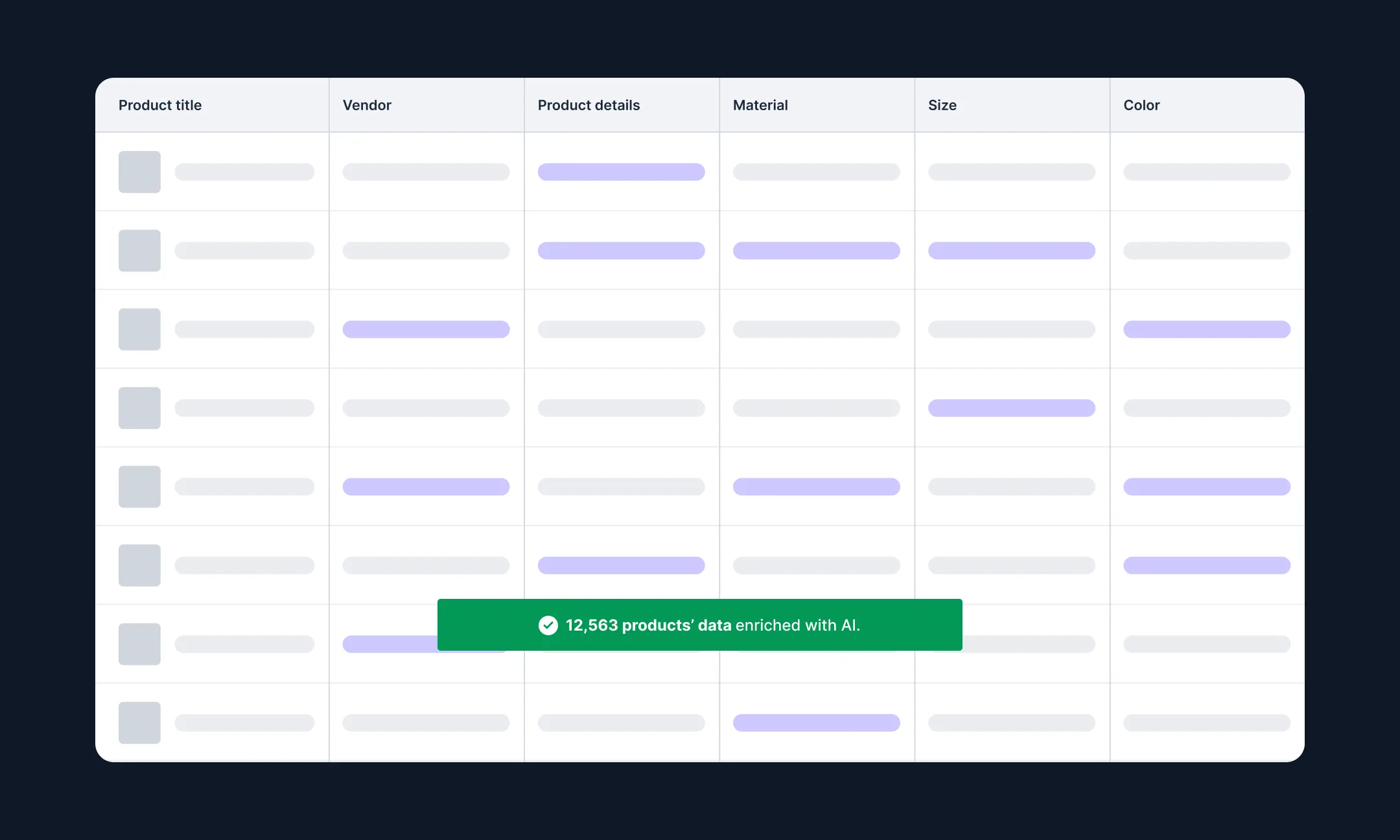
Categorizes and tags products against your taxonomy, and maps each product to the category each channel requires.
Fills missing attributes from supplier feeds, spec sheets, product images and the web, with a source and confidence score on every value.
Validates titles, specs, variants and assets to catch missing fields before they reach Shopify.
Publish approved data to Shopify
Maps each attribute to the right Shopify field, including metafields and variant fields.
Routes every change through your approval workflow and role permissions, so nothing publishes without sign-off.
Keeps Shopify and your catalog aligned with ongoing two-way sync.
Launch faster and boost product visibility with AI


Launch faster and boost product visibility with AI


When does a Shopify store need a PIM?


Frequently Asked Questions
What is a Shopify PIM?

A Shopify PIM is a product information management system that sits upstream of your Shopify store. It holds the master record for each product's attributes, variants, images and content, improves that data in one governed place, then publishes approved values to Shopify. Hypotenuse AI is an AI-first PIM with enrichment and content generation built in.
Is Shopify a PIM?
No. Shopify is a commerce platform built to sell products, and a PIM is built to manage and improve the data behind them. Shopify stores products, variants and metafields, and Shopify's own PIM guide describes it as a platform that integrates with PIMs. Teams with large catalogs run a PIM upstream and sync clean data into Shopify.
Do we need a PIM if we are already on Shopify?
Shopify on its own works for a small catalog managed by one team in one store. A PIM earns its place once you manage thousands of SKUs across more than one market or channel, or once several teams and suppliers edit the same records. Hypotenuse AI centralizes that data, fills gaps and applies your rules, then syncs approved values back to Shopify.
How does the Shopify connection work?
Connect your Shopify store and choose which products and fields to sync, including variants and metafields. Enrichment and content generation happen inside Hypotenuse AI, where your team reviews and approves. Approved values are written back to the Shopify fields you mapped during setup, and the sync runs both ways as products change. See how Shopify product data enrichment works.
Can a PIM manage Shopify metafields and variants?
Yes. Hypotenuse AI syncs variants and metafields from Shopify and maps each enriched attribute to the field it belongs in, including metafields and variant fields. Shopify allows up to 2,048 variants and three options per product (Shopify Help Center), so details such as dimensions or care instructions usually live in metafields.
What should you look for in a PIM for Shopify?
Check four things: a direct Shopify connection that maps to metafields and variant fields, validation that holds back incomplete products before they publish, approvals and permissions for every team that edits product data, and the capacity to run across your full catalog in bulk. For a side-by-side of PIM platforms, see our guide to the best PIM software for ecommerce.
Will it overwrite product content we have already written?
Only where you allow it. You choose which fields Hypotenuse AI is allowed to write to, and nothing is pushed back to Shopify until it has been approved.
How many products can it process at once?
Hypotenuse AI is built for bulk work and runs across catalogs from a few thousand products to several million. Jobs run in the background, so you are not processing products one at a time.
How accurate is the generated content?
Every enriched value carries a confidence score, the reasoning behind it and the source it came from. Confidence thresholds are configurable per attribute, so low-confidence values route to a review queue while high-confidence values flow through automatically.
Can we try it on a few products first?
Yes. Teams usually start on a sample of products to check output against their brand voice and attribute rules, then widen to the full catalog once the setup is right.
.avif)