


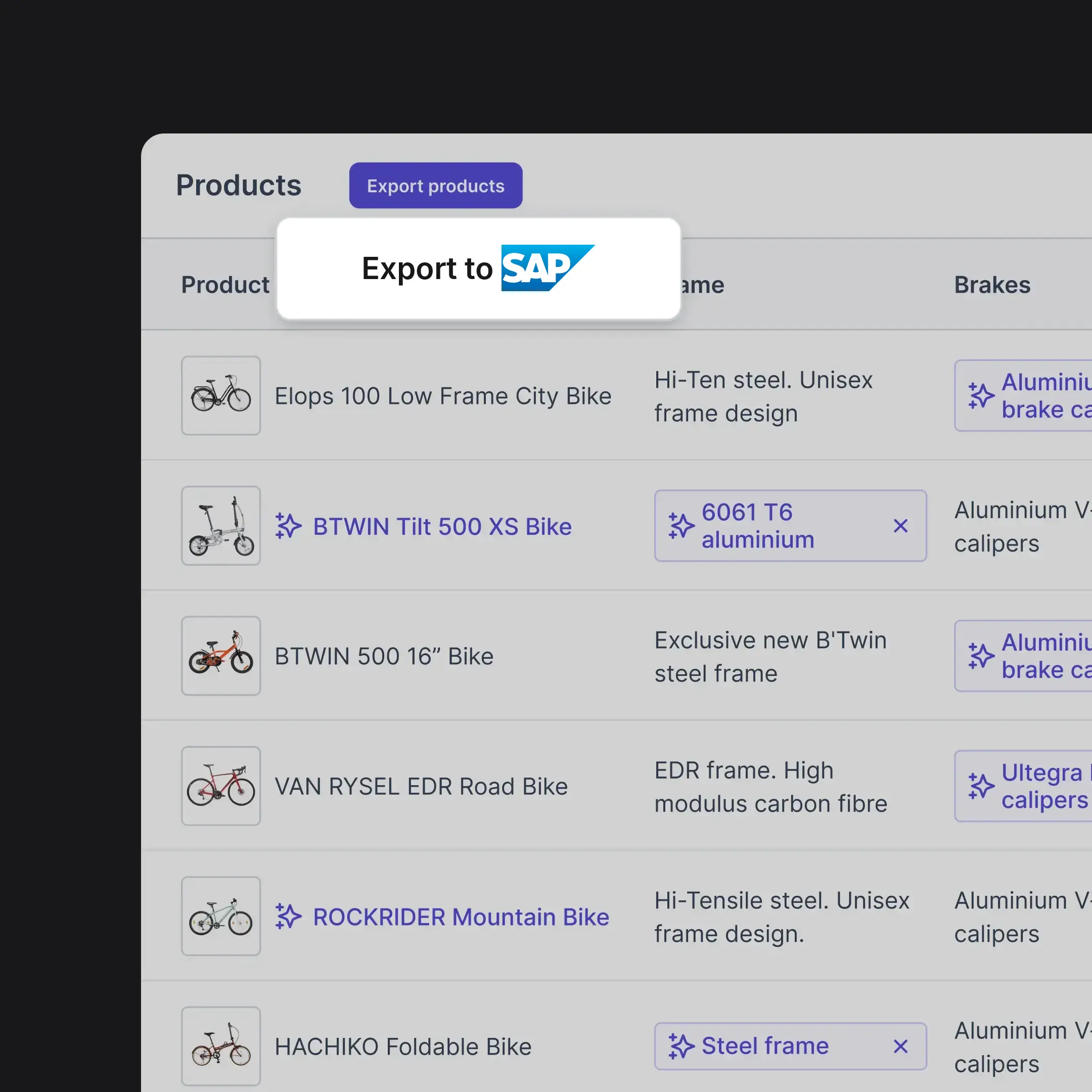
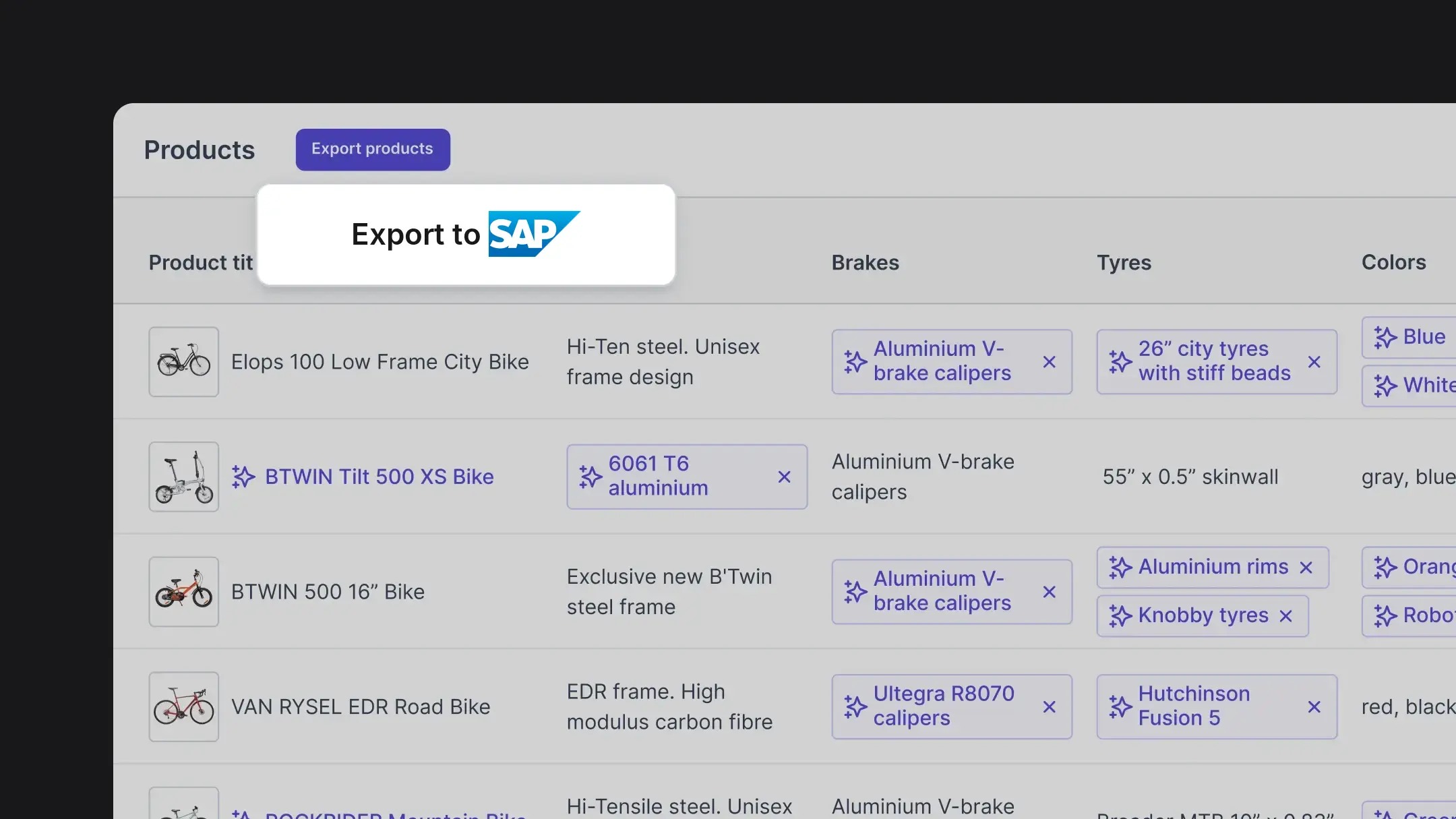









Sync your SAP product data

Syncs product master data from S/4HANA and catalog data from SAP Commerce Cloud in bulk, across your full catalog.
Combines your SAP records with product data from supplier feeds and your other systems.
Models variants and product relationships in a data structure that scales with your catalog.
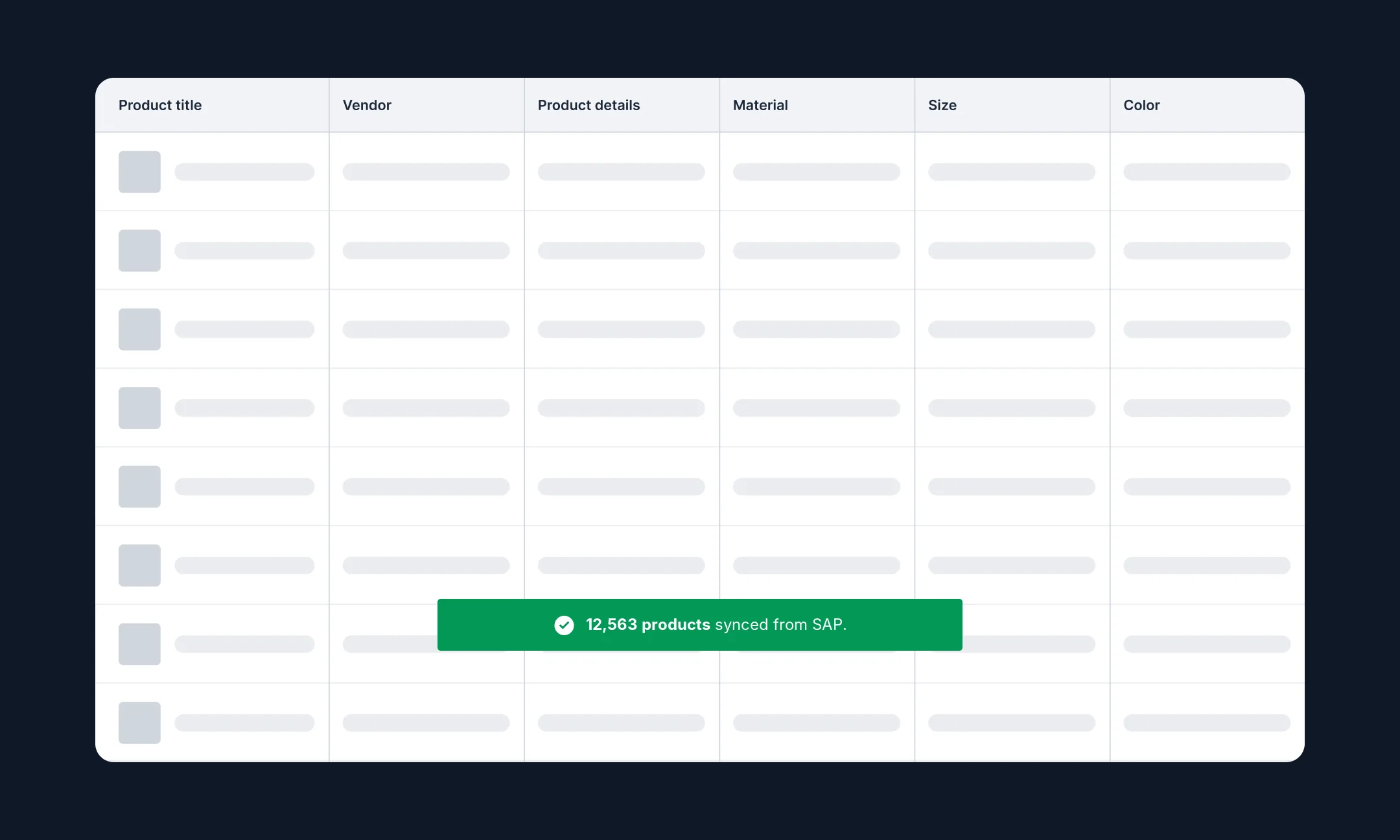
Enrich and check product data
Enriches and standardizes product data, filling gaps and fixing values that are wrong or inconsistent.
Tags and categorizes products against your taxonomy and each channel's requirements.
Checks content and data for tone, accuracy, completeness and compliance before anything syncs.
Publish approved data to SAP
Maps each value to the right field in SAP Commerce Cloud, including classification attributes and variant products.
Sends approved updates to your Staged catalog, so your team syncs them to Online as it does today.
Routes every change through your approval workflow and role permissions, so nothing publishes without sign-off.
Launch faster and boost product visibility with AI


Launch faster and boost product visibility with AI


When does an SAP business need a PIM?


Frequently Asked Questions
What is an SAP PIM?

An SAP PIM is a product information management system that works alongside SAP. S/4HANA stays the system of record for the product master, and SAP Commerce Cloud runs your storefront. The PIM holds product attributes, content, images and channel versions, improves them in one governed place, then syncs approved data into SAP and out to your channels. Hypotenuse AI works as your SAP PIM: an AI-first PIM with enrichment and content generation built in.
Does SAP have a PIM?
Only for its own storefront. SAP Commerce Cloud includes product content management for the catalog it runs, and S/4HANA holds the product master for operations. Neither is built to hold product content for every channel you sell through. A PIM holds that content for your storefronts and marketplaces, and adds the enrichment and approvals a large catalog needs.
Do we need a PIM if we already use SAP?
You need one once you manage thousands of SKUs across several storefronts or marketplaces, or once several teams and suppliers edit the same products. SAP on its own works when one team runs one storefront and the catalog holds everything that storefront needs.
How does Hypotenuse AI work with SAP?
Hypotenuse AI pulls product data from S/4HANA, SAP Commerce Cloud and your other systems, enriches attributes and generates content, then syncs approved data back to SAP through a PIM integration. Your team reviews and approves inside Hypotenuse AI before anything publishes. You can also start from a CSV or Excel export of your catalog.
Can Hypotenuse AI work alongside a PIM we already have?
Yes. If you already run a PIM next to SAP, product data flows from the PIM into Hypotenuse AI for enrichment and content generation, then back to your PIM or out to SAP Commerce Cloud. If you don't, the AI-native PIM inside Hypotenuse AI holds your product data and feeds SAP directly.
What should you look for in a PIM for SAP?
Check four things when you compare PIM software for ecommerce: whether it maps to your classification attributes and variant products, which data syncs with S/4HANA in each direction, validation that holds back incomplete products before they publish, and whether it can run across your full catalog in bulk.
How many products can it process at once?
Hypotenuse AI is built for bulk work and runs across catalogs from a few thousand products to several million.
